Morocco is one of the safer countries you can ride in, and the risks are not the ones people worry about. Here is what actually goes wrong, and what we do about it.
Published
Yes. Morocco is consistently one of the safest countries in Africa for travellers, and the High Atlas is safer for cycling than most European road networks — because there is almost no traffic on the trails we ride. Violent crime against tourists is rare, and in the mountain valleys it is close to unheard of.
That said, "safe" is not the same as "nothing to think about". The things that genuinely cause problems for cyclists here are not the things people email us about. Below is what actually goes wrong, ordered roughly by how often we see it.
The real risks, in order
In fifteen years of running trips, the incidents that have needed a response have overwhelmingly been these, in this order: dehydration and heat exhaustion, crashes on loose descents, stomach upsets, and sunburn. Not crime. Not being lost. Not the things travel advisories talk about.
Dehydration is first by a distance, and it is the one people take least seriously. The air here is extremely dry, so you do not feel yourself sweating. It evaporates before you notice it. A rider can lose a great deal of fluid on a two-hour climb and register it only as tiredness. This is why our guides push water at every stop, sometimes irritatingly.
Traffic
Moroccan driving in cities is assertive and lane discipline is loose. Marrakech traffic is genuinely chaotic, and we do not ride in it. Every tour starts with a transfer out of the city and ends with one back in. That is a deliberate design decision, not laziness.
On the mountain roads, traffic is light and drivers are generally courteous to cyclists. The specific hazards are blind hairpins on the passes, grands taxis overtaking optimistically, and the occasional unlit vehicle at dusk. On our road and gravel routes the support vehicle sits behind the group on exposed sections for exactly this reason.
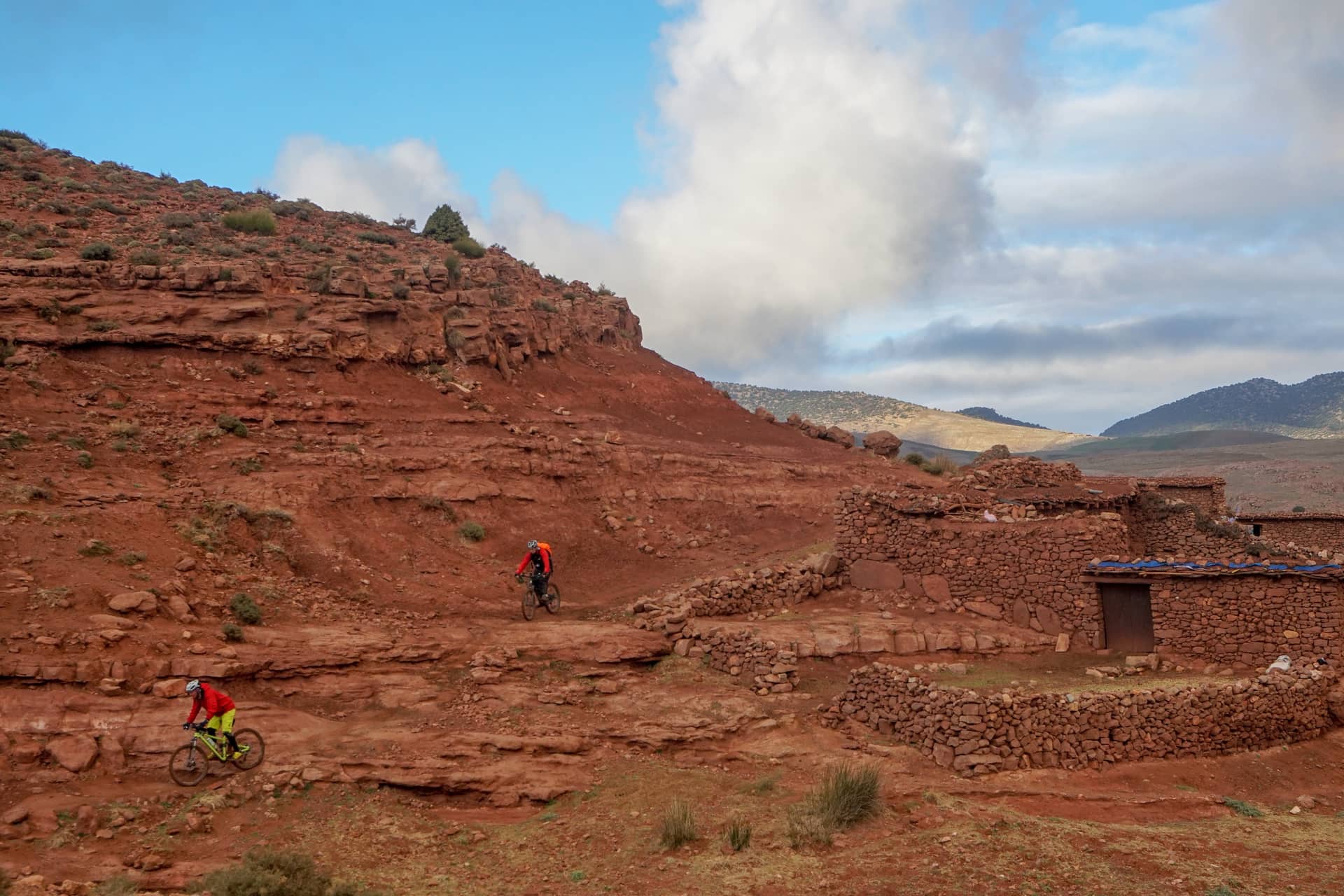
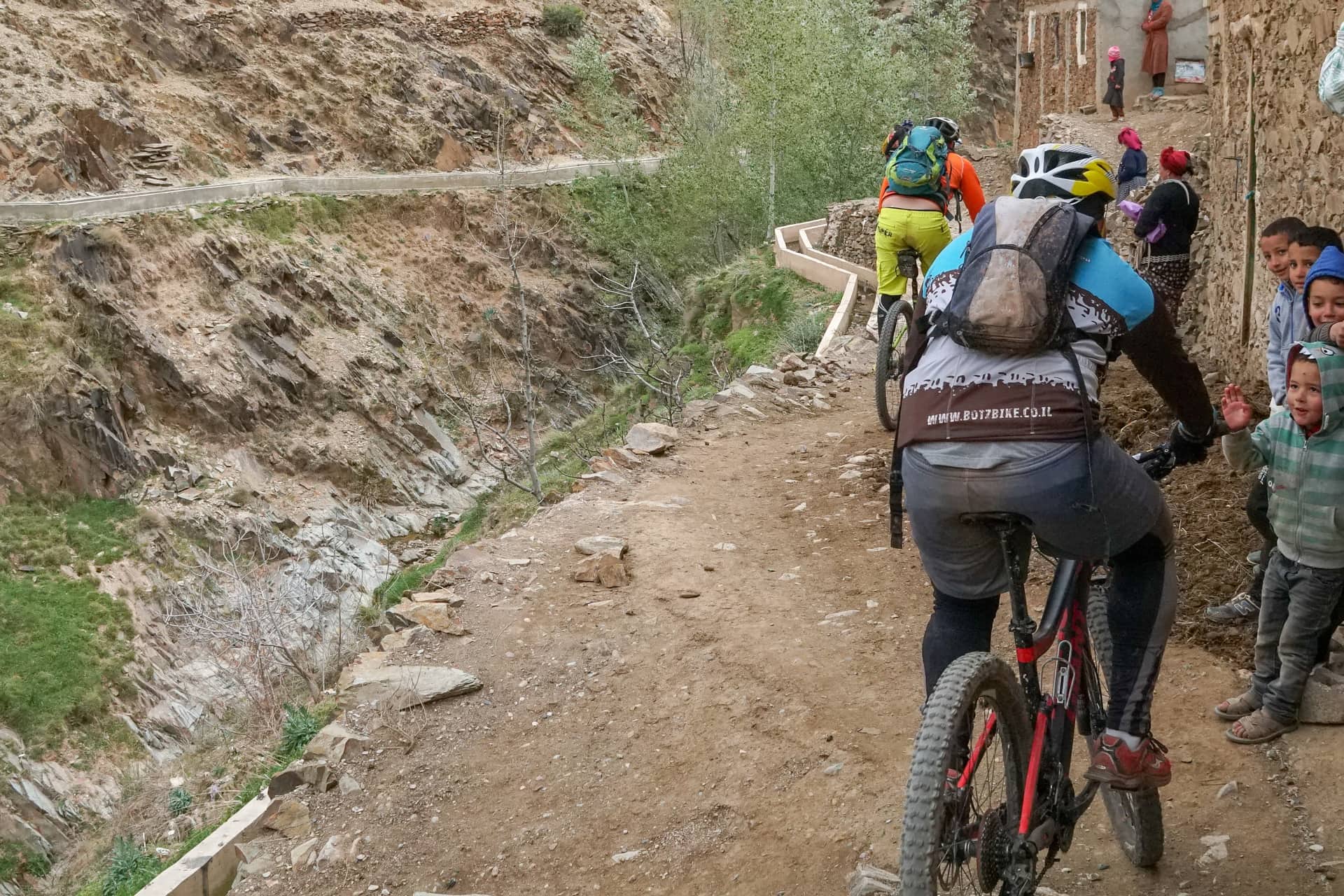
On the trails, which is where you will spend most of a mountain bike tour, the traffic is mules, sheep and children. The mules have right of way and know it. Slow down, do not ring a bell at them, and let them pass on the inside.
Dogs
Village dogs will bark and some will chase. In seven years we have had no bites on a tour. The technique is unglamorous but works: stop pedalling, put a foot down, do not shout, do not accelerate. A dog chasing a moving bicycle is doing its job; a dog facing a stationary human loses interest quickly.
Rabies exists in Morocco. It is worth discussing a pre-exposure vaccination with your travel clinic if you are riding for two weeks or more, though for a standard week most doctors will say the risk does not justify it. That is a conversation for your GP, not for us.
Solo and female riders
Solo female travellers ride with us regularly, and experienced solo female bikepackers have written extensively about Morocco being a good destination for exactly this. The honest picture is that the issue in Morocco is not danger, it is attention — persistent hassle from touts and street vendors, overwhelmingly in the medinas and tourist areas of the big cities.
In the mountains this essentially disappears. Village culture in the High Atlas is conservative, hospitable and protective towards guests. Women riding through Amazigh villages get waves and curiosity, not harassment. Several of our regular clients are women who ride solo and specifically chose Morocco after being nervous about it.
Practical notes that help: shoulders covered is customary for women in Morocco, and normal cycling kit is fine on the bike but a light layer for villages and stops is respectful and reduces attention. Riding with a local guide changes the dynamic in your favour almost completely. You are visibly a guest of someone from here rather than an unaccompanied stranger.
Medical cover and what happens if you crash
This is where you should focus your attention, because it is the part that is genuinely your responsibility. Mountain rescue in the Atlas is not free, and there is no equivalent of a European air-ambulance-by-default arrangement.
- Your travel insurance must explicitly cover cycling. Many standard policies exclude it entirely.
- For enduro and downhill, the policy must name those activities. Most do not, and a policy that excludes your activity will not pay.
- Check the repatriation limit, not just the medical limit. Repatriation is the expensive part.
- Carry a copy of the policy number where a guide can find it, not only on your phone.
On our side: every guide carries a first-aid kit and is trained in first aid, the support vehicle is never more than a road-crossing away, and there is a hospital in Marrakech within about ninety minutes of most of our routes. Phone signal in the valleys is patchy but present in more places than you would guess.
Water, food and stomach upsets
Do not drink tap water in the mountains. Bottled water is provided on our tours and is available everywhere in the valleys. Ice in the villages comes from the same tap water, so decline it outside proper restaurants.
Food in the gîtes is cooked fresh by the family and is, in our experience, less likely to cause problems than a mid-range restaurant in the city. The usual advice applies — hot food, freshly cooked, avoid salads washed in tap water. Bring rehydration sachets. A day of stomach trouble is not dangerous but it will cost you a riding day if you do not manage the fluid loss.
Altitude
The passes we ride sit between 2,100m and 2,660m. That is high enough to notice on a climb and not high enough for altitude sickness in any normal sense. The threshold for that is generally around 2,500m for sustained exposure, and we sleep lower than the passes we cross.
What you will notice is that a climb feels harder than the same gradient at home, and that the temperature drops sharply at the top. Riders regularly get cold at a pass on a warm day because they arrived sweating and then stopped. Carry a layer and put it on before you cool down, not after.
What we actually do about all of this
Groups are two to twelve riders, which means a guide can see everybody. The 4x4 shadows the route with water, spares and lunch. Guides are trained in first aid, bike maintenance and navigation, and they are from these valleys — which matters more than it sounds, because knowing which trail washed out in last week’s rain is not something you learn from a map.
And we will tell you if a tour is wrong for you. If your group is not ready for the enduro trip, we would rather sell you the 3-day Atlas Mountains MTB tour that you will enjoy than the advanced one you will endure. Declining a booking is a safety measure too.
Common questions
Is it safe to cycle in Marrakech itself?
We do not recommend it and we do not do it. City traffic is genuinely chaotic and the medina is pedestrian-dense. Every tour transfers out of the city to the trailhead. If you want to ride near the city, the [Agafay desert and the Lalla Takerkoust road](/bike-tours/2-day-high-atlas-gravel-bike-tour) are much better options and only a short drive out.
Do I need vaccinations for Morocco?
No vaccinations are required for entry from most countries. Hepatitis A and tetanus are commonly recommended, and rabies is worth discussing if you are staying a long time. Check with a travel clinic four to six weeks before you fly. This is a medical question, not one for a tour operator.
What about riding during Ramadan?
It is fine, and the mountains are quiet and beautiful then. Our guides may be fasting, which we will tell you in advance. Read our guide on [riding during Ramadan](/blog/morocco-cycling-during-ramadan) for what actually changes.
Is the political situation stable?
Morocco is politically stable and tourism is a major part of the economy, including in these valleys specifically. Check your own government’s current travel advice before booking any international trip. That is standard practice, not a Morocco-specific caution.