You will ride through a dozen villages a day and it is easy to see them as scenery. They are not. Here is what you are actually looking at.
Published
The people of the High Atlas are Amazigh. The indigenous people of North Africa, here long before the Arab conquests of the seventh century. "Berber" is the word most visitors know, and it is still widely used in Morocco including by Amazigh people themselves, but it descends from the Greek barbaros, meaning foreigner or barbarian. Amazigh means "free people", and it is what they call themselves.
You will ride through a dozen of their villages on a single day here. This is what you are looking at when you do.
Why the villages are where they are
Notice, as you ride, that villages sit on the steep unproductive slope rather than on the flat valley floor. That is not an accident of history or a preference for the view. Flat ground next to water is the only farmland there is, and it is far too valuable to build on.
So the houses climb the hillside, stacked so that one roof is the next house’s terrace, and every square metre of the valley bottom is terraced, irrigated and planted with walnut, cherry, barley and maize. The density of the settlement is a direct consequence of the scarcity of soil.
What the buildings are made of
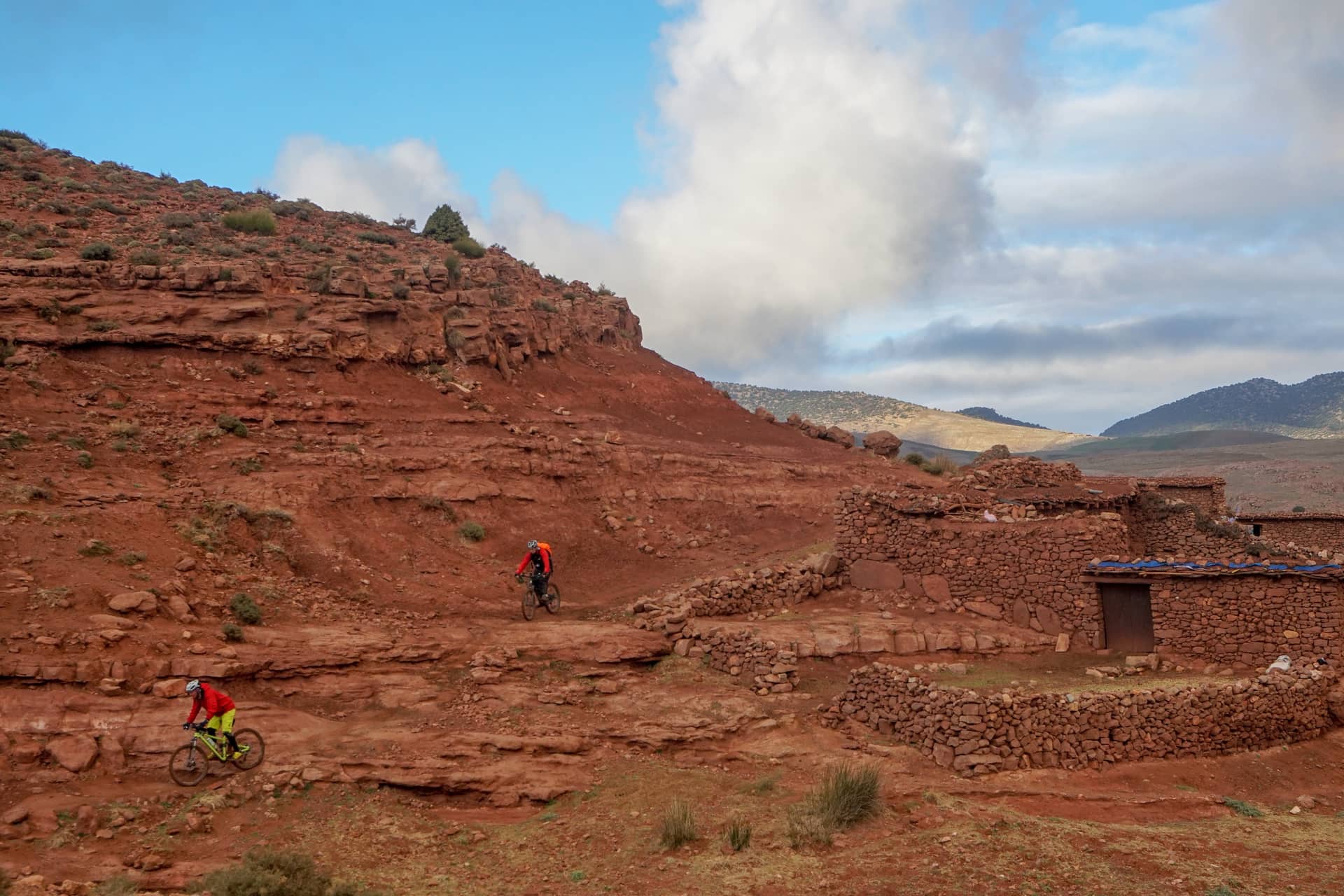
Pisé — earth rammed into timber formwork in layers, each layer tipped in and compacted before the next goes on. When the formwork comes off, the horizontal seams between lifts stay visible for the life of the wall. Once you have noticed those bands you will see them everywhere.
It is a superb material for this climate. Thick earth walls hold the night’s cold through the afternoon and release the day’s heat after dark, which is why a pisé house at 1,600m is comfortable in July without any mechanical cooling. It also needs constant maintenance, which is why the roofs are re-rendered every few years and why an abandoned house dissolves back into the hillside within a generation.
Two structures are worth recognising. A tighremt is a fortified house with crenellated corner towers. A family stronghold, built when the valleys were dangerous. An agadir is a communal fortified granary, where the whole village stored grain and valuables behind one lockable door under the management of an elected keeper. Both tell you the same thing: this was, for a long time, a place where wealth had to be defended.
The water, which is the real story
The channels you cross constantly on the trails are seguia — irrigation canals, some of them many centuries old, running along the contour to carry snowmelt from high in the valley to terraces far below.
The water in them is shared under a rota that predates the Moroccan state. Each household gets the flow for a fixed period, measured traditionally in units of time rather than volume, and the schedule is administered by the village assembly. Disputes over water rights are the oldest form of local law here, and the system still functions without any external enforcement.
That assembly is called the jemaa. A council of household heads that makes decisions collectively about water, grazing, the mosque and the maintenance of paths. Including, as it happens, the paths you are riding on.
The symbols
Amazigh weaving and painted decoration use a symbolic vocabulary that is worth knowing, because you will see the same handful of signs on rugs, doors, pottery and tattoos across the whole range.
- The lozenge or diamond — protection, and by extension the feminine and fertility. The single most common motif in Aït Ouaouzguite weaving.
- The zigzag — water, in a region where water is the difference between a valley and a canyon.
- The cross or plus. The four cardinal directions, and orientation.
- The yaz, ⵣ. The letter Z in Tifinagh, the Amazigh script, and now the central symbol on the Amazigh flag. Adopted as a marker of identity within living memory.
Tifinagh itself is worth a second look. It is an ancient script, descended from Libyco-Berber writing that is more than two thousand years old, and it was recognised as official in Morocco only in 2011 alongside the Tamazight language. You will now see it on road signs and public buildings. The angular geometric characters next to the Arabic and French.
Language
In the High Atlas the language is Tashelhit, one of the three main Amazigh languages of Morocco. Most people in the valleys also speak Moroccan Arabic, many speak French, and in villages with tourism some speak English.
Four words will change your day. Azul is hello in Tamazight. Tanmirt is thank you. In Arabic, salam or salam alaikum works everywhere as a greeting, and shukran is thank you. Using the Tamazight rather than the Arabic in a mountain village is noticed and appreciated. It signals that you know where you are.
How to be a good guest on a bike
A cyclist moves through a village faster than a walker and slower than a car, which makes you unusually visible. A few things genuinely matter.
- Slow right down through villages. Children play in these lanes and there is no pavement. It also makes greeting people possible, which is the whole difference between passing through and visiting.
- Greet people. A raised hand and a salam costs nothing and is returned every time.
- Ask before photographing anyone, particularly women. A landscape is not the same as a person’s family.
- Do not hand out sweets or money to children. It is well-meant and it establishes tourists as a source of handouts, which changes how the next visitor is treated. If you want to give something, give it to the school or to the household hosting you.
- Mules have right of way, always. Stop, put a foot down, let them pass on the inside. Do not ring a bell at them.
- Cover shoulders and knees off the bike. Cycling kit is fine while riding; put a layer on when you stop in a village.
- Accept the mint tea. It is the entire transaction of being welcomed somewhere.
Why local guides are not a marketing line
Our guides are Amazigh and from these valleys. The practical value of that is real: knowing which trail washed out in last week’s rain, which household will feed twelve people at an hour’s notice, whose grandfather to ask about the pass. None of that is on a map.
The economic value is equally real. Money spent on gîtes, cooks, muleteers and guides stays in the valley. Small groups are part of that. A village of two hundred people can absorb six riders in a way it cannot absorb sixty, and the difference between those numbers is the difference between tourism that supports a place and tourism that changes it into something else.
That is not a reason to feel virtuous about your holiday. It is a reason to ride slowly through the villages, learn two words, and accept the tea.
Common questions
Should I say Amazigh or Berber?
Amazigh is the term Amazigh people use for themselves and it is increasingly standard. Berber is still widely used in Morocco, including in tourism and by Amazigh people speaking to visitors, and nobody will be offended by it. Using Amazigh signals that you have paid attention.
Is it appropriate to photograph the villages?
Landscapes and architecture, yes. People, only with permission — ask, or have your guide ask. Women in particular may not want to be photographed and a refusal should end the conversation immediately.
What should I bring as a gift if I am staying with a family?
Nothing is expected. If you want to bring something, tea, sugar or good coffee from home are appropriate and useful. Avoid alcohol entirely and avoid giving money directly to children.
Do the villages actually benefit from tourism here?
In the valleys we work in, yes and visibly — gîte income, guiding work, mule hire and food sales are a meaningful part of household income. That depends entirely on operators using local accommodation and local staff rather than bussing everything in from Marrakech, which not all of them do.